
ABOUT JMD
OUR GOAL
Our goal is to fulfill each customer’s vision with the highest level of creativity and perfection.
Whether Formula 1 driver or hobby pilot—the project is only complete when the customer is fully satisfied!
So far, 44 Formula 1 drivers have trusted in JMD paintwork—8 of them in the 2019 season alone.
Since 2001, JMD designs have contributed to 8 world championship titles in Formula 1. This makes us,
by far, the most frequently represented helmet design brand in the pinnacle of motorsport over the past
two decades. With 16 different helmet designs created for Sebastian Vettel in just one season, we hold
the record for the highest level of creative variety. Our professional collaboration with drivers, teams,
and sponsors has made us the most respected partner on the grid.
DRIVER
When Fernando Alonso expressed his interest in a collaboration for the 2012 season, the JMD team was more than thrilled. After all, you don’t get one of the best Formula 1 drivers of the present day as a customer every day! As an avowed helmet fan, Fernando now owns an extensive collection, which can be admired at the MUSEO FERNANDO ALONSO.
Although Rubens Barrichello had to be convinced of a collaboration with JMD during his time as Michael Schumacher’s teammate at Ferrari, over the course of his career we managed to inspire him with new colors and effects, enhancing his traditional helmet design.
Nico Hülkenberg has been one of our customers since 2011 and completely changed his helmet design with us. With his move to Renault, we developed the current retro design together, and lo and behold: in a FIA poll, the latest version in the black/yellow color combination was voted the most beautiful helmet of the 2018 grid.
Felipe Massa is one of JMD’s most loyal customers. Since his time as a test driver at Scuderia Ferrari in 2003, we have accompanied the Brazilian, celebrated his “almost-world championship title” in the 2008 season, and worried about his health after his accident at the Hungarian GP the following year. He is, after Michael Schumacher, the second driver for whom we painted two farewell helmets. Even in Formula E, his helmet in the Brazilian colors is painted by JMD.
When the then Force India F1 Team secured BWT as a new main sponsor for the 2017 season, branding not only the racing cars but also the entire driver outfit with its logo and colors, the flexibility of the JMD team was put to the test. Within a very short time, we adapted Esteban’s helmet — a homage to Michael Schumacher’s classic red design — to the new branding, and we have been cooperating ever since.
He is one of the friendliest drivers in F1, and it is always a pleasure for us to plan new projects with him. Daniel has been part of the JMD customer circle for over 10 years, and his special helmets are always a talking point in the paddock. The Honeybadger on his helmet was also graphically realized by us and has since become his trademark.
Since 2005, Nico has been a JMD customer, and we have accompanied him from his first race in F1 to his greatest successes. Initially still with his father’s colors, his design changed in 2012 — with the help of his wife Vivian — to the chrome/carbon look he kept until winning the world championship in 2016.
The son of multiple rally world champion Carlos Sainz came to JMD as a Red Bull Junior before his time as a Formula 1 driver. For the past two years, the helmet design has been planned in collaboration with Spanish designer Dave Designs.
Even before Sebastian Vettel regularly changed his helmet design, Timo Scheider was a testing ground for our creative output. Apart from the basic lines, none of his helmets has stayed the same since his days as a Formula 3 driver in 1997, and the color experiments continue even after his active DTM career. Along with René Rast, he is one of our long-standing customers.
Working as a helmet designer for the premier class of motorsport is exciting enough, but when the reigning world champion got in touch in 2001 and inquired about our work, a new chapter in JMD’s company history began. Up to his last race in 2012, we accompanied the career of the most successful Formula 1 driver of all time with over 500 painted helmets and 4 world championship titles. The collaboration with him was as professional as his racing career. Every detail of his helmet design was important to him. With his special helmet at the USA GP 2001, a few weeks after 9/11, for the first time in F1 history a helmet carried a statement. After the race, it was auctioned for a record sum in aid of the victims of the attacks.
Besides Daniil Kvyat, he is the second Russian Formula 1 driver to trust in JMD’s work. His existing design was supplemented by the typical Williams Martini stripes and refined several times during the season.
Especially in the late phase of his active Formula 1 career, Adrian Sutil developed into a true helmet design fan and also contributed his creative ideas. Already as a kart driver he was a JMD customer, and up until his last Formula 1 race in 2014, we created some of the coolest JMD helmet designs with him.
When Max Verstappen came to us as a Red Bull Junior driver 8 years ago, no one could foresee that he would become one of the greatest talents in modern Formula 1 history, and we are proud to have been part of his career. In the meantime, Max’s orange Spa helmets have become world-famous, and it’s always a lot of fun to bring his ideas and visions to life.
When, in 2007, Sebastian was preparing for his first Formula 1 race in Indianapolis and had too many ideas for just two helmets, he and Jens Munser decided to at least use two of them and paint both helmets differently. Over time, this turned into a whole collection of ideas, and before each new helmet, new concepts were planned. To this day, it is still the case that we propose ideas to Seb, and then plan the final version with him.
In the summer of 2012 in Monza, the 50th helmet design was delivered. Contrary to the widespread opinion that Seb gets a new helmet for every race, it is rather the case that each new Arai helmet gets a new design. What is true, however, is that a helmet with which he has won gets a place of honor in a showcase and is no longer used. Since 2015, the FIA has stipulated that designs may only be changed for one race per season. Since then, we have limited ourselves to the same basic design, composed of white and the German colors. Even so, there is still enough room for our creations. In total, over 130 different designs have been created and painted so far. And really, there is no reason to stop…
Workshop
From Idea to Realization
A perfect environment is the prerequisite for perfect, creative work. On 600 m², the JMD
workshop is divided into the paint shop, administration/computer design, and dedicated
workstations for helmet paint design. In the paint area, our team has a room with
computer-controlled positive pressure as well as two spray booths.
In 2014, our professional paint booth from Wolf was installed. Clean-room conditions make
the work easier and guarantee a flawless finish. In addition, two paint-mixing benches,
various warming ovens, and short-wave infrared drying emitters are used to enable efficient
workflows.
We use only professional spray guns from Sata, operated with cold-dried compressed air and filled with paints from Spies Hecker and Teleplast.
As a rule, we work with a conventional acrylic-based coating system that has been
specialized and adapted—together with chemists and paint technicians—to the specific
challenges of helmet design.
In planning and printing, a total of five Apple iMacs and one MacBook Pro are connected to
the company server. Print jobs are handled by a Roland VS-640 solvent printer. Stencils for
detailed paintwork are cut with a Summa plotter into solvent-resistant masking films.
It is not uncommon to test using old helmet shells shot with an air rifle. This simulates a
high-speed stone impact quite accurately.
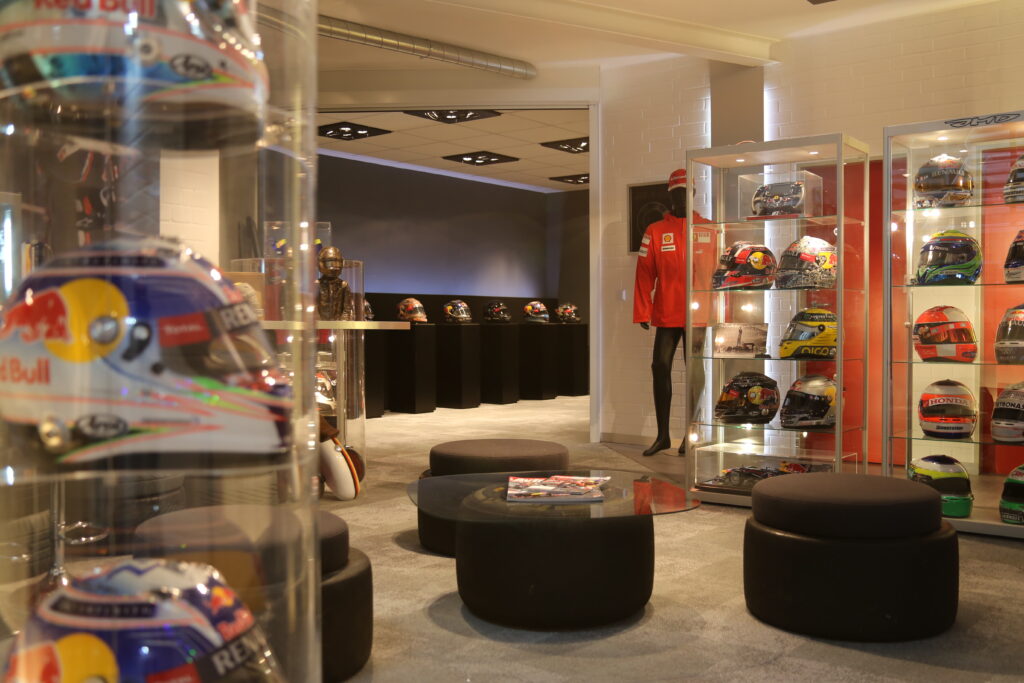
Showroom
Zur Gallerie
History
Jens Munser started “small” in 1989 in his parents’ basement, where he first tried customizing his own motocross helmets with an airbrush to match his riding gear. Inspired by the work of Troy Lee, an American pioneer in helmet paintwork, Jens experimented enthusiastically with colors and motifs.
THE RIGHT TECHNIQUE
After many trials and plenty of learning, it became clear that combining paintwork, airbrushing and graphic design is essential to achieve outstanding results on helmets. Visits to and observations in auto paint shops as well as design and advertising agencies brought new insights that helped optimize our work: the simple fact that a helmet is round already makes the job challenging. Special tools we developed in-house are used to mark perfectly parallel lines, for example. The right technique also requires the right paint system. Even in his early days, Jens used a special approach to keep paint amounts low and spare riders unnecessary weight. With his own toolkit of pigments and binders, the paintwork on Schumacher’s helmet weighed only about 25 grams!
DESIGN DEVELOPMENT
Your design is your signature. In close dialogue, the design is developed, refined and perfected together with the customer. A core principle at JMD is that every rider receives a tailor-made design and paint job exactly as desired. For inspiration, the JMD website showcases more than 1,000 realized helmet designs.
THE FIRST CLIENTS
Good design attracts attention, as Jens quickly discovered. Other motocross riders wanted custom helmets, and demand kept growing. Jens presented his work at motorcycle trade shows and exhibitions and benefitted from short lines of communication in the paddocks, which made his designs so well known that in 1993 he decided to turn his hobby into a full-time profession as “JMD” (Jens Munser Designs). The right decision, as it turned out: at a motorcycle show, Peter Bürger—the Arai importer for auto and kart helmets—noticed JMD’s work. He needed a partner to expand his offering with professional paintwork, and after talking, the match was made. JMD enriched the portfolio with unconventional ideas and filled a market gap: instead of simple colorful stripes, individuality was in demand. From then on, the helmet surface was used to express oneself, convey messages and show personality on the track.
THE ROAD INTO FORMULA 1
The inquiry that paved JMD’s way into Formula 1 came from Japan in 1998: Toranosuke Takagi, a Japanese F1 driver, was looking for a special green chrome design—which he found at JMD, where we had already been experimenting with chrome-based designs. These chrome helmets enabled the first step into F1. The next client was Nick Heidfeld, then still in Formula 3000 but already planning an F1 project with Schuberth helmets. Through our cooperation with Schuberth came the ultimate “dream client”: Michael Schumacher—his helmet design was initially adopted and, over the years of collaboration, modified based on JMD’s suggestions. He was followed by Ralf Schumacher, Giancarlo Fisichella, Mark Webber, Rubens Barrichello, Nico Rosberg, Felipe Massa, Daniel Ricciardo, Sébastien Buemi, Adrian Sutil, Nico Hülkenberg, Fernando Alonso and Sebastian Vettel—who had his first helmet painted at JMD when he was eight years old.
HELMETS BEYOND FOUR-WHEELED SPORTS
Among all JMD customers, Pit Beirer—one of Germany’s most successful motocross riders—was particularly close to Jens’s heart. A big fan of the paintwork from Salzgitter, he was the only motocross rider to keep his own consistently unchanged design over many years. In the summer of 2003, a serious accident ended his career, and JMD ultimately withdrew from motocross as well.
With Sven Hannawald, the company had its first contact with winter sports—up close when Sven became the first ski jumper to win all individual events of the Four Hills Tournament in 2001. Felix Loch, Aksel Lund Svindal, Thomas Morgenstern and Lindsey Vonn were among several other exceptional athletes who followed. Even football stars like Lukas Podolski, Franck Ribéry, Sergio Agüero and sprint star Usain Bolt now own helmets from Salzgitter.
HELMETS FOR SPECIAL OCCASIONS
JMD established the helmet as an ideal communication surface that, alongside sponsor logos, provides space for designs that powerfully convey emotions and messages. A prime example was Michael Schumacher in 2001, when—after the attacks on the World Trade Center—he replaced the German flag with the American flag on his helmet: a political statement on a helmet, a world premiere!
Since then, messages have more often been carried outward via the helmet—for example with Giancarlo Fisichella, who celebrated Italy’s 2006 World Cup title and his 200th Formula 1 start with his helmet design.
After the serious accident at the Hungaroring in 2009, Rubens Barrichello used his helmet to send a message to his injured friend Felipe Massa—a gesture whose image went around the world!
Nick Heidfeld wanted something truly special when, at his request in 2007, a helmet with thermochromic paint was created for the first time—changing its design several times over the course of the race weekend.
For Michael Schumacher’s farewell race with Ferrari in Brazil, JMD prepared a very special surprise for the record world champion: all elements such as the dragon, logo and stars were applied in genuine gold leaf. In addition, the upper red ring was adorned with a listing of all 91 venues, including the years, where he won.
The theme of “farewell” was also creatively implemented for one of Vettel’s helmets marking his move from Toro Rosso to Red Bull: a collage of images from the first F1 victory for Toro Rosso and Sebastian Vettel.
In 2012, rally legend Walter Röhrl received his helmet with JMD design—and a piece of history from former co-driver Christian Geistdörfer—for his 65th birthday. Nico Rosberg’s expression of joy over Germany’s 2014 World Cup win did not align with FIFA’s lawyers: they prohibited him from wearing a painted image of the World Cup trophy on his helmet at his home GP in Hockenheim. In the paddock and in front of running cameras, Jens Munser had to rework it into four stars. FIA President Jean Todt, Niki Lauda and Dietrich “Didi” Mateschitz were also presented with JMD helmets; in all three cases, their life’s work was woven into the design with images and illustrations.
THE VETTEL HELMET ART COLLECTION
The indecisiveness of Sebastian Vettel and Jens Munser led Sebastian to change his helmet paintwork so often. For his first F1 race with BMW, there were too many ideas for too few helmets—so they were distributed across subsequent ones. The Vettel Helmet Art Collection took off: during his time at Red Bull Racing alone there were 94 different designs, and by 2018 the number had grown to over 130 variations of striking, effective headgear— with no end in sight. Even after the move to Ferrari and the FIA’s ban on fundamentally changing the helmet design constantly, Sebastian has remained experimental with us. The German flag running asymmetrically across the helmet and the mostly white front have—aside from a few exceptions—always been retained.
THE FUTURE
JMD has established itself worldwide as the go-to address for helmet paintwork. With a team of 14, we not only design helmets but also create drafts and products as gifts for teams and sponsors. It has become clear that JMD’s many ideas should not be limited to helmets; going forward, the company presents itself as one that brings design and style together with motorsport—the very fascination that has accompanied JMD from the beginning to this day.